A Ukrainian notary’s stamp can confirm a translator’s signature, yet a foreign authority may still ask for a translation made under its own rules. The key question isn’t simply which country you’re travelling to; it’s which office will receive which document, and for what procedure.
The short answer: there is no reliable list of countries that always reject every Ukrainian notarized translation. Germany, Poland, France, and Italy have procedures where local rules may require a particular kind of translator or certification. Other procedures in those same countries may have different rules.
A translation can be accurate and notarized in Ukraine, but still fail a receiving authority’s formal requirements. Notarization, apostille, legalization, and acceptance of the translation answer different questions. Sorting them out before you submit can save you from reordering the translation after an application is already underway.
What a Ukrainian notarized translation proves, and what it doesn’t¶
A notarized translation is a translation whose translator’s signature has been certified by a notary under the relevant procedure in Ukraine. The notarial act doesn’t automatically turn the translation into a document accepted by every foreign authority.
That distinction matters because a receiving office can care about several separate things:
- Is the original document authentic, and does it need an apostille or legalization?
- Does the document need to be translated at all?
- Which language must the translation use?
- Must the translator be sworn, certified, officially appointed, or approved in the receiving country?
- Does the authority accept a translation notarized in Ukraine, or does it require a different certification?
- Must the translation include stamps, handwritten notes, attachments, or the reverse side of the original?
A notary’s certification doesn’t answer all those questions. It may certify a signature or another aspect of the notarial act, but the receiving authority still decides whether the translation’s form meets its rules.
The word “notarized” can make a document sound universally official. In practice, an authority may recognize the Ukrainian notarial act yet still ask for a translation prepared by a translator it accepts. The problem isn’t necessarily that the translation is wrong. The problem may be that the translator’s status or the form of certification doesn’t match the procedure.
That difference is why the question “Does this country accept Ukrainian translations?” often leads to the wrong answer. A country isn’t one single receiving office. A court, university, registry office, migration authority, and consulate can each apply different rules. Even one authority may treat education documents differently from civil-status documents.
For a clearer explanation of these terms, see sworn, certified, and notarized translation explained. The important takeaway is simple: don’t treat notarization in Ukraine as a guarantee that every authority abroad will accept the translation as submitted.
How acceptance works in practice¶
The receiving authority sets the rules for its own procedure. The document’s country of issue, the language it uses, the purpose of submission, and the authority’s local requirements can all affect the result.
A useful way to picture the process is as two separate checks. First, the authority considers the original document: its origin, authenticity, and whether it needs an apostille or legalization. Then it considers the translation: its language, completeness, translator status, and method of certification. Passing one check doesn’t automatically pass the other.
An apostille is a certificate used to confirm the authenticity of a public document for use abroad where the relevant arrangements apply. Germany’s Federal Foreign Office explains that an apostille can replace legalization for a public document from a country covered by the Hague Convention, subject to exceptions or other arrangements. That check concerns the original document’s authenticity. It doesn’t decide whether the translation’s language or form is acceptable.
Germany’s Federal Foreign Office also explains that a translation doesn’t become a public document just because a translator’s stamp or certification appears on it. A translation therefore can’t ordinarily be apostilled or legalized as if it were the original public document. A separate official document confirming a translator’s status or signature may be treated differently.
If the receiving office asks for an apostille, ask which document needs it. The request may concern the original, not the translation. If the office asks for a sworn translation, adding an apostille to the original won’t turn a Ukrainian notarized translation into one prepared by a locally recognized sworn translator.
Before you commission anything, get a written answer from the authority that will receive the paperwork. Ask about the exact document and procedure, not just whether it “accepts Ukrainian translations.” A precise question produces a usable answer: “For this procedure, will you accept a Ukrainian translation certified by a Ukrainian notary, or must a translator appointed in your country prepare or certify it?”
The official guidance can also be specific to the document type. A rule for recognizing education documents doesn’t necessarily apply to a migration application. A multilingual form that removes the need for a translation for one public document doesn’t mean every document can be filed without translation.
For a wider overview of acceptance rules and common document issues, read whether foreign countries accept Ukrainian notarized translations.
What Germany, Poland, France, and Italy require¶
These countries aren’t best described as places that “don’t accept Ukrainian translations” across the board. Their official guidance shows why a more careful question is needed: does this authority accept this translation for this procedure?
| Country | What official guidance says | What to check before submitting |
|---|---|---|
| Germany | A translation required by an authority or court should be done by a sworn or certified translator in Germany. | Whether the receiving authority requires a translation and whether it will accept a Ukrainian notarized version. |
| Poland | Some procedures require a Polish sworn translator. A specific education-recognition procedure has language exceptions, including for Ukrainian. | Which procedure applies, and whether its exception covers your document and submission. |
| France | A translator agréé is a court expert listed by a court of appeal or the Court of Cassation. Requirements can vary by procedure and location. | Whether the authority requires an approved translator and whether special rules apply abroad. |
| Italy | A foreign act intended for use in Italy must come with an Italian translation certified by a competent diplomatic or consular mission or an official translator. | Which certification route the authority accepts for your document and procedure. |
Germany: a Ukrainian notarial stamp may not be enough¶
Germany’s Federal Foreign Office says that when authorities or courts require translations of foreign documents, the translation should be done by a sworn or certified translator in Germany. The guidance makes clear why a Ukrainian notary’s certification on its own can’t guarantee acceptance in a particular German procedure.
“If German authorities and courts require translations of foreign documents, these translations should be done by a sworn or certified translator in Germany.”
The statement comes from the Federal Foreign Office of Germany. For the reader, the practical point is that the requested translator status matters independently of whether the Ukrainian translation was notarized.
Germany provides a public database of translators and interpreters where you can search for translators officially authorized, appointed, or sworn in the federal states. The rules for appointment depend on the law of the relevant state, so the database is a way to find an eligible translator, not a substitute for checking what the particular authority requires.
The database also describes transitional arrangements for some translators appointed under earlier state rules. Germany’s federal law on court interpreters took effect on January 1, 2023, and some translators may rely on a general oath in court until December 31, 2027, under conditions in § 189(2), according to the official database, checked on April 25, 2026. Those dates concern translators’ status, not a general deadline for applicants or documents.
If you’re preparing paperwork for Germany, ask the recipient whether it requires a sworn or certified German translator. Also ask whether the original needs an apostille or legalization. The two requests concern separate parts of the file, and one doesn’t replace the other.
Poland: the procedure can change the answer¶
Polish requirements provide a clear example of why a country-level yes or no isn’t enough. For foreign-language documents filed in a migration matter at the Poznań Voivodeship Office, the office requires a Polish translation made by a Polish sworn translator, according to its official guidance. The office advises applicants to confirm current requirements for their specific case before filing.
A different rule applies to a particular procedure for obtaining a general opinion on foreign education or confirming equivalence of educational documents. That procedure requires a certified translation by a Polish sworn translator from the Ministry of Justice list, but its guidance says the requirement doesn’t apply to applications concerning documents issued in English, French, German, Russian, or Ukrainian, according to the education-recognition page, checked on April 25, 2026.
The exception belongs to that education procedure. It isn’t a general exemption for Ukrainian documents submitted to every Polish authority. A Ukrainian certificate filed in a migration matter and a Ukrainian education document submitted through the specified recognition process may face different translation rules.
The Polish education page also warns that the Ministry may refuse a translation if the sworn translator certifies a translation from a language they aren’t authorized to translate. Its example is a Russian translator certifying a translation from Ukrainian or Belarusian. The warning is about the translator’s authorization for the source language, not about whether the translator knows enough Ukrainian.
“The Ministry may refuse to accept a translation in a situation where the translator misuses the above mentioned rights by additionally certifying translations from other, similar languages (e.g. a translator of Russian certifies translation of Ukrainian or Belarusian documents).”
The Polish education-recognition guidance makes this a practical check: confirm the translator is authorized for the document’s actual source language. Similar-looking or related languages aren’t interchangeable for this purpose.
That same education procedure sets format requirements for multi-page translations. Pages need a signature and stamp on each page, or they must be fastened so they can’t be separated, with a signature and stamp on the last page, according to the official guidance, checked on April 25, 2026. Don’t assume that a format rule in one procedure applies to every Polish office, but do check the page’s instructions if your case falls under it.
France: look for the approved translator rule¶
In France, a translator agréé is a court expert listed by a court of appeal or the Court of Cassation. France’s official Service Public guidance advises applicants to check the procedure because requirements can differ in France and abroad.
That guidance also describes a limited route for certain public documents issued in one EU country and submitted to an authority in another EU country. A multilingual standard form may allow those documents to be filed without translation, but the receiving authority can still request a translation. If it does, the translation must be done by a translator agréé, according to the official page, checked on April 25, 2026.
That EU route doesn’t automatically apply to Ukrainian documents. Ukraine isn’t an EU member, so a Ukrainian public document doesn’t qualify just because a similar document issued by an EU country might use the multilingual-form procedure. Check the exact document and its country of issue before relying on an exemption.
For submissions from abroad, the process can depend on the relevant consulate. The French guidance says a consulate may publish a list of locally approved translators, and the translator’s signature may need material certification by the consulate. “Approved translator” can therefore mean a particular route for a particular location, rather than simply a translator who works in French.
“Toutefois, l’autorité destinataire du pays européen (UE) peut demander une traduction si nécessaire. Dans ce cas, la traduction doit être faite par un traducteur agréé.”
Translation: “However, the receiving authority in the European Union country may request a translation if necessary. In that case, the translation must be done by an approved translator.”
The quote is from France’s Service Public. The authority’s right to request a translation is the detail to keep in mind: a multilingual form may help in a defined case, but it doesn’t guarantee that an office will waive the translation.
Italy: certification of the Italian translation matters¶
Italy’s Foreign Ministry says that a foreign act intended to be valid in Italy must be accompanied by an Italian translation whose conformity is certified by the competent diplomatic or consular mission or by an official translator. The ministry’s guidance on translation conformity cites DPR 445/2000, Article 33, and EU Regulation 2016/1191, checked on April 25, 2026.
“Un atto straniero che debba valere in Italia deve essere accompagnato da una traduzione in italiano, certificata conforme dalla rappresentanza diplomatico-consolare competente o da un traduttore ufficiale.”
Translation: “A foreign act intended to be valid in Italy must be accompanied by an Italian translation certified as conforming by the competent diplomatic or consular mission or by an official translator.”
The quote comes from Italy’s Foreign Ministry. Its practical significance is that a Ukrainian notarial certification shouldn’t automatically be treated as equivalent to the certification routes listed by the Italian ministry.
EU Regulation 2016/1191 also allows multilingual standard forms for certain public documents in some cases. An authority in an EU country may accept the form instead of a translation if it considers the information sufficient. The rule applies to defined documents and doesn’t create a blanket exemption from translation. Ukraine’s status outside the EU also means you shouldn’t assume the route applies to a Ukrainian-issued document.
Italy’s instructions refer to a foreign act and the Italian translation that accompanies it. Ask the receiving office whether it accepts a Ukrainian notarized translation or whether it requires certification through an Italian diplomatic or consular mission or an official translator. Confirm whether the original also needs separate authentication.
Common reasons a translation gets held up¶
A refusal or request to resubmit doesn’t always mean that the translation contains a language error. Formal problems can arise when the document, translator, certification, or filing procedure doesn’t match the receiving authority’s requirements.
Assuming an apostille fixes the translation¶
An apostille addresses the authenticity of a public document. A translation’s acceptable language, translator status, and certification are separate issues. Germany’s Federal Foreign Office explains that a German apostille confirms a public document’s authenticity, while translation form remains a separate question.
Ask whether the apostille is needed on the original and whether the translation needs a local sworn translator. Don’t treat the apostille and the notarial certification as interchangeable stamps. Each has a different purpose.
For more detail on the distinction between a translation and a copy certified by a notary, see notarial copy versus notarial translation.
Treating one office’s rule as a national rule¶
A Polish education-recognition exception for Ukrainian-language documents doesn’t establish a general rule for every Polish authority. A migration procedure in Poznań has a different stated requirement. In France, the official instructions also say that the applicable process can depend on the procedure and, for submissions abroad, on the consulate.
Identify the actual recipient before you order. “Poland accepts this” is too broad to be useful. “This education-recognition procedure lists Ukrainian among the languages covered by its exception” is the kind of statement you can verify against the procedure’s own instructions.
Choosing a translator authorized for the wrong language¶
A translator’s experience with Russian doesn’t establish authorization to certify Ukrainian. The Polish education-recognition guidance specifically warns that the Ministry may refuse a translation when a translator certifies a source language they aren’t authorized for.
Check the translator’s authorization for the original language, not just the language of the finished translation. Ask the translator and the receiving office if the source document is bilingual or contains sections in more than one language.
Leaving out stamps and handwritten details¶
A translation can miss information that appears outside the main printed text: a seal, handwritten annotation, or stamp. For a certified translation, those details can matter just as much as the typed body.
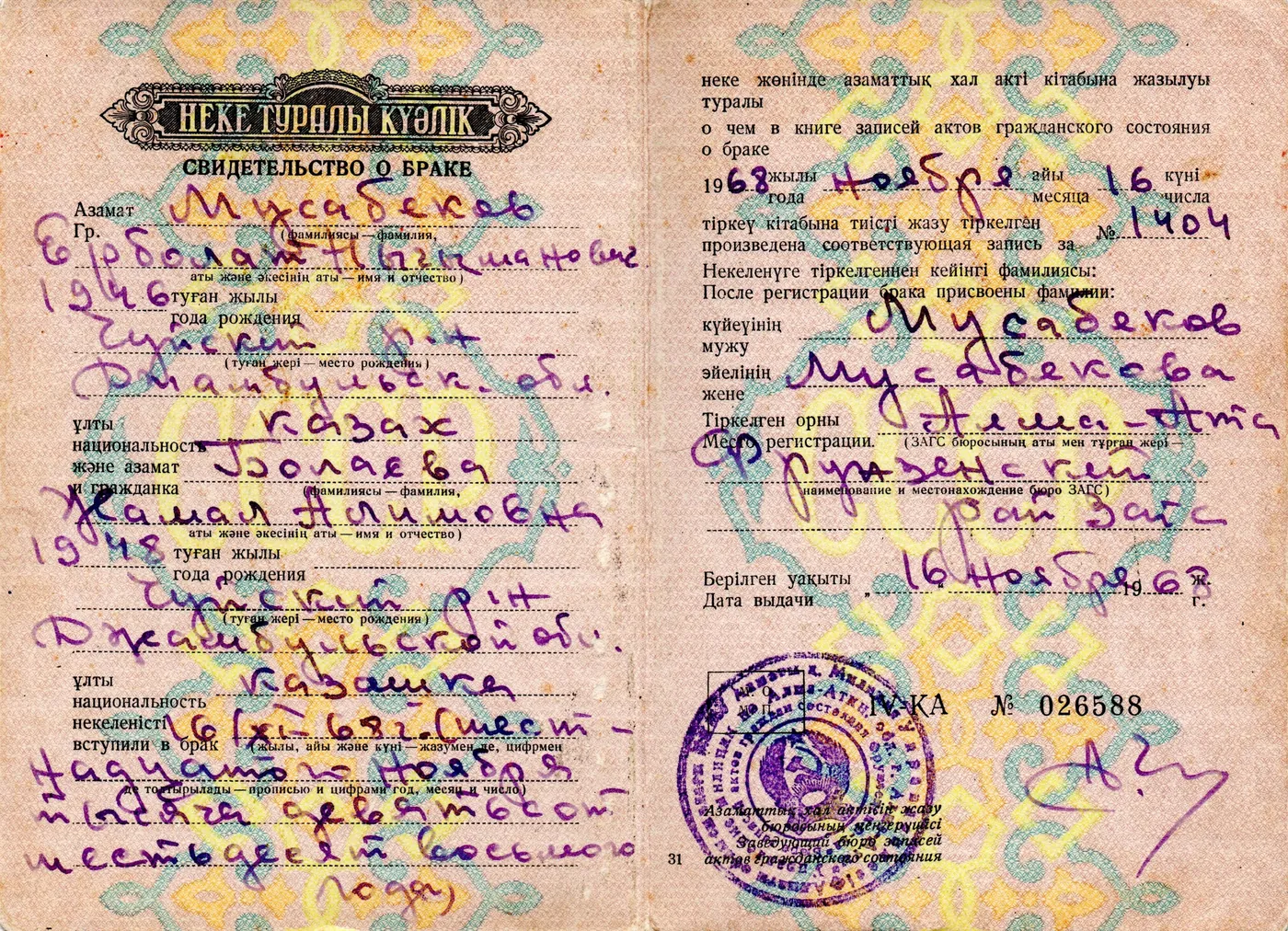
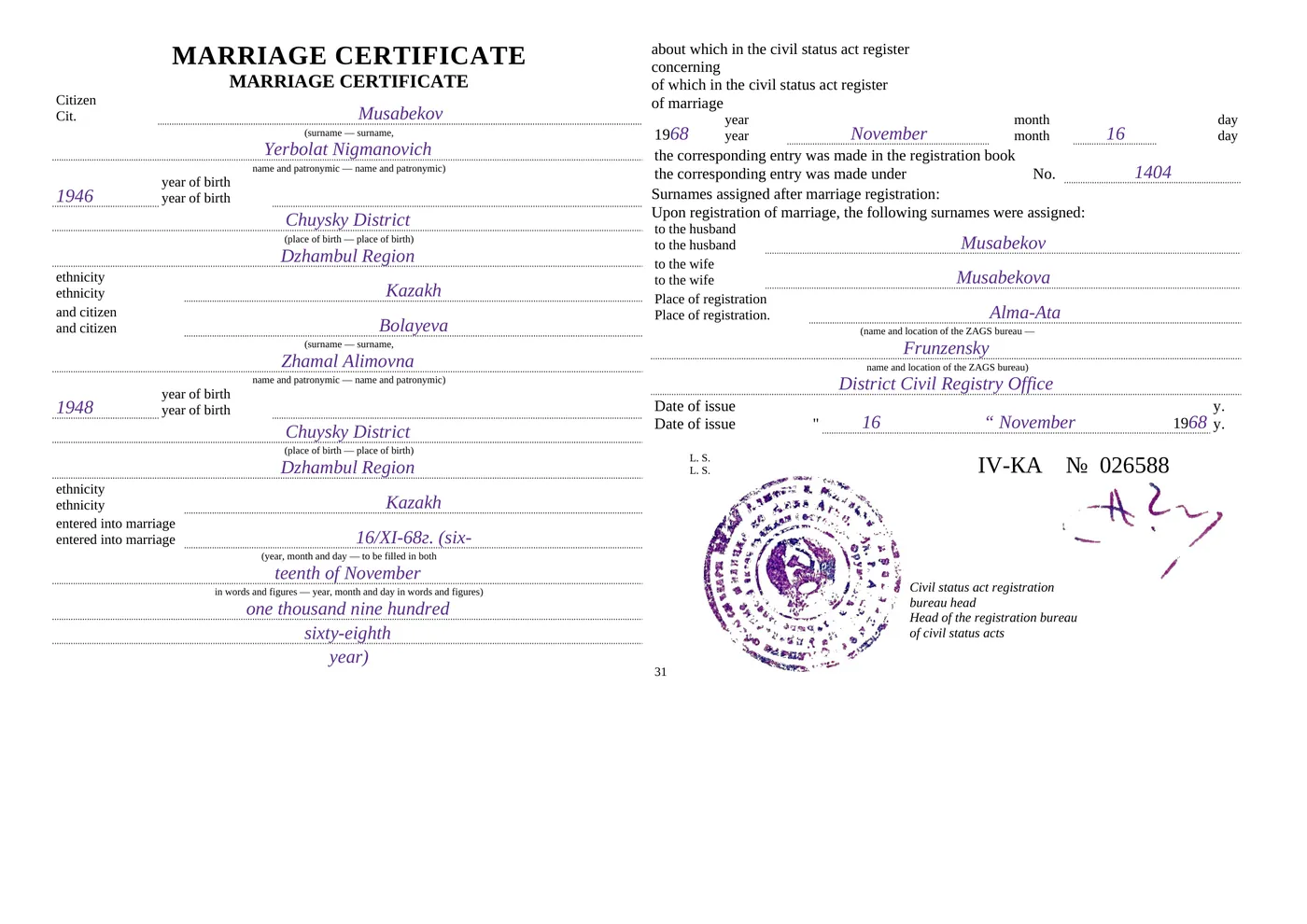
I keep the stamp in the same place as a picture and put a short bracketed note right below it with the words read from the stamp, like “[Stamp: …]”. A translator needs those words as text because a certified translation has to translate the stamp too, and retyping a round stamp by hand is where words get lost.
The example shows why the translation should account for the whole page, not just its main paragraph. When you review a draft, compare it against the original and check stamps, seals, signatures, handwritten notes, and text on the reverse side. If a stamp is too unclear to read, ask how the receiving authority wants that handled rather than silently omitting it.
A document-translation tool can help with a different part of the task: preserving layout when a PDF or scan contains tables, headings, or stamps. In ChatsControl, you can upload a document or scan and receive a formatted Word translation; the tool can keep a stamp as an image and add a note with the words read from it. Handwriting and badly degraded scans remain unreliable, so check the result against the original and don’t treat an automated translation as a substitute for the translator status or certification your authority requires.
Ordering before the recipient confirms the format¶
A translation can be accurate yet not usable for the application because it follows the wrong certification route. Before paying for a translation, ask the receiving authority whether it accepts a Ukrainian notarized version or requires its own sworn, approved, or official translator.
Save the answer and the instructions you used. If the authority later asks for something different, those details can help you work out whether the problem concerns the document, the translator, or a change in procedure. The authority’s answer is more useful when your question describes the exact document and purpose.
For practical background on a notarial translation’s form and use, see what a notarized translation is and when you need one.
How to check the rules before you submit¶
A short check with the receiving authority can prevent a mismatch between the translation you’ve ordered and the one its procedure requires. Work through the questions below in order.
- Name the receiving authority and procedure. Identify the specific court, registry office, university, migration authority, or other recipient. State what application you’re filing rather than asking about acceptance in the country as a whole.
- Describe the document. Give its type, country of issue, and original language. Mention if it’s bilingual, contains handwritten entries, or includes stamps and attachments.
- Ask whether a translation is needed. Some rules allow a multilingual form for defined documents. Don’t assume that an exemption applies to your document or to a document issued in Ukraine.
- Confirm who may translate it. Ask whether the office accepts a Ukrainian notarial translation or requires a sworn, certified, approved, or official translator under local rules.
- Ask about authentication of the original. Confirm whether the original needs an apostille or legalization. Keep that question separate from the requirements for the translation.
- Check the required format. Ask whether the translation must cover stamps, both sides, attachments, and handwritten notes, and whether pages need a particular signature, seal, or binding.
- Keep the authority’s answer. Save the response or the official instructions you relied on, and check them again before submitting if the procedure has changed or you have a different document.
A useful message can be direct: “I need to submit a Ukrainian-issued [document type] in [language] for [procedure]. Will you accept a translation certified by a Ukrainian notary, or must it be translated or certified by a translator approved in your country? Does the original need an apostille or legalization?”
Ask the authority about each part of the file separately. A yes to “Can I submit a Ukrainian document?” may not answer whether the translation needs a specific translator. A yes to “Is an apostille required?” doesn’t establish that the translation is acceptable.
If an authority says it needs a local translator, ask how to find one. Germany provides a public search database for translators and interpreters. France’s official guidance points readers to approved translators and notes that consulates may publish local lists. Poland’s education-recognition procedure refers to sworn translators on a Ministry of Justice list. For Italy, ask whether the office accepts certification through a diplomatic or consular mission or an official translator.
FAQ¶
Which countries reject Ukrainian notarized translations?¶
There is no general list of countries that always reject every Ukrainian notarized translation. Germany, Poland, France, and Italy have procedures that may require a translation made or certified under local rules, but requirements depend on the document and the receiving authority.
Will Germany accept a Ukrainian translation certified by a notary?¶
A Ukrainian notary’s certification doesn’t guarantee acceptance in a German procedure. Germany’s Federal Foreign Office says that translations required by German authorities or courts should be done by a sworn or certified translator in Germany.
Does Poland require a sworn translator for Ukrainian documents?¶
Some Polish procedures do, including the stated migration-document rule for the Poznań Voivodeship Office. A specific education-recognition procedure has an exception for documents issued in Ukrainian, so check the rules for your exact procedure.
Do I need an apostille on the translation or on the original?¶
An apostille concerns the authenticity of a public document, not whether a translation meets the recipient’s language and translator requirements. Germany’s Federal Foreign Office says that a translation doesn’t become a public document merely because it has a stamp or certification.
How do I check translation rules for a foreign authority?¶
Ask the receiving authority about the exact document and procedure. Confirm the required language, translator status, apostille or legalization for the original, translation completeness, and whether consular certification is accepted.
Need these documents translated?
Leave your number and we will message you, tell you which certification your institution needs, and name the price. Translation, translator review and notary certification.