A degree title that looks familiar in English can still cause trouble if a translation turns it into a different credential. For a Ukrainian Candidate of Sciences or Doctor of Sciences diploma, the first job is to identify the exact document and degree, then follow the recipient’s rules for translation, copies, and authentication.
That distinction matters especially when an application is for a German university, an employer, or the Central Office for Foreign Education, known as ZAB. A translation can communicate what the document says, but it doesn’t decide whether a foreign authority considers the qualification equivalent to a German one.
What the translation needs to preserve¶
A scientific degree diploma is an official record of an awarded academic qualification. Its translation should preserve the wording and details shown on the document, not silently convert the credential into a more familiar foreign title.
Ukraine’s Ministry of Education and Science publishes separate forms for Doctor of Sciences, Doctor of Philosophy, and Doctor of Arts diplomas. That makes the basic check straightforward: identify the document’s exact title and type before translating it (Ministry of Education and Science forms, guidance as of November 2026).
A Candidate of Sciences diploma must not be treated as interchangeable with every diploma that contains the word “doctor.” A Candidate of Sciences degree may be treated as equivalent to a Doctor of Philosophy qualification in a particular context, but that does not mean a translator should replace its title with “PhD.” Equivalence is a decision made under the receiving authority’s rules, not a shortcut for translation.
The same caution applies to Doctor of Sciences. A translator should reproduce the credential as it appears and make the relationship between the original wording and its English or German rendering clear. Where the recipient has its own preferred terminology, use that instruction rather than guessing.
A useful translation usually has to carry more than the degree name. The reader may need to identify the issuing institution, the holder, the date, the specialty, and any seals, signatures, or notes that appear on the document. A missing stamp or an altered name can make a faithful-looking translation incomplete.
The Ministry’s separate forms help explain why a precise document title matters. They distinguish Doctor of Sciences, Doctor of Philosophy, and Doctor of Arts rather than grouping them under one general label (Ministry of Education and Science, as of November 2026).
Start with the recipient’s checklist¶
Before asking for a translation, find out who will receive the diploma and what the application is for. A university may have one document list, an employer another, and an evaluation authority a separate process.
For a ZAB application, the general checklist asks for certified copies of the diploma and academic transcript. The translation is submitted as a regular copy, and the checklist says that documents in English, French, Italian, Spanish, or Arabic don’t need translation. The same page warns applicants to use the general checklist only when the country where the qualification was earned doesn’t have its own country-specific page (ZAB general checklist, guidance as of November 2026).
That distinction is easy to miss: the copy of the original document may need certification, while the translation itself may be requested as a regular copy. Don’t assume that “certified copy” means “notarized translation.” Check which item in the checklist each instruction applies to.
ZAB also asks applicants assessing a PhD or doctoral qualification to submit previous degrees and transcripts if those qualifications were earned. The checklist therefore may involve more than the scientific diploma alone: a master’s and bachelor’s diploma, plus their transcripts, may also be relevant (ZAB general checklist, guidance as of November 2026).
A practical document checklist:
| Document or detail | What to check before ordering |
|---|---|
| Candidate of Sciences or Doctor of Sciences diploma | Confirm the exact title, holder’s name, issuing institution, date, specialty, and visible notes. |
| Academic transcript or supplement | Check whether the recipient asks for it and whether it needs translation. |
| Earlier degrees | For a ZAB doctoral assessment, check whether the applicant also needs the earlier degrees and transcripts. |
| Certified copies | Confirm which original documents need certified copies. ZAB distinguishes these from the regular copy of the translation. |
| Stamps and signatures | Make sure the translator can read and account for every visible official marking. |
| Apostille or other authentication | Ask the receiving authority whether it requires one before arranging it. |
A diploma supplement isn’t automatically required just because a scientific diploma exists. The recipient’s list decides whether to translate it. When the list asks for an academic transcript, check whether the supplement is the document that supplies that information, rather than ordering a translation of every related paper without checking.
If you have a qualification issued in Ukraine, ZAB’s Ukraine page says Ukrainian qualifications can be checked through EDEBO. Its listed database includes Ukrainian higher education diplomas earned from 2012, while military higher education institutions aren’t covered by that listed information (ZAB Ukraine information, guidance as of November 2026).
For refugees from Ukraine who lack documents, the same page describes a Plausibilisierung procedure, with the required steps supplied in the online application process. That is a specific process for missing documents, not a reason to send an incomplete file without following the instructions (ZAB Ukraine information, guidance as of November 2026).
Choosing a translation option¶
The right option depends on what the recipient asks for, the state of the source document, and whether the final translation needs formal certification. A translation service can’t decide the recipient’s requirements for you, so use the checklist as the starting point.
Translation bureau¶
A bureau can be a practical choice when you need a human translator to work from a paper original, clarify a difficult stamp, or coordinate a certified translation. Ask what the quoted service includes: translation only, review, formatting, certification, or delivery of a printed copy.
Before handing over a diploma, ask how the service will treat names and degree titles. A translator should preserve the original credential rather than quietly converting it into “PhD” or “Dr.” Ask whether stamps and handwritten notes will be translated too, and whether the provider needs a scan or the original for the selected service.
A certified translation is a separate requirement from an accurate translation. If a recipient requires a certified or notarized version, ask which person must certify it and what form the recipient accepts. The label “official translation” on a provider’s website doesn’t prove that a specific university or authority will accept the result.
Freelance translator¶
A freelancer may suit a straightforward diploma when the recipient accepts an ordinary translation and you can verify the translator’s language and subject-matter experience. Agree on the source and target languages, the exact documents included, how names will be represented, and whether the quoted work covers stamps and seals.
A freelancer’s translation isn’t automatically notarized or certified. If the recipient requires that step, ask how it will be arranged and who is responsible for the certification. Keep the source file and the translation together so you can compare names, dates, and degree titles before submitting.
Online document translation¶
An online tool can help when the document is a clear scan and you need a translated file whose layout remains readable. For a diploma, the visual arrangement matters: fields, seals, signatures, and the relationship between labels and entries can all help a reviewer understand the document.
In ChatsControl, you upload a DOCX or PDF and receive a translated Word file with the document’s layout, headings, and tables kept in place. For a scan or phone photo, the system reads the page first and rebuilds a formatted Word copy. A bilingual review view lets you compare the original and translation side by side. ChatsControl can help prepare a working translation, but an AI translation isn’t a substitute for a certified human translation when the recipient requires certification. Handwriting and badly degraded scans can also be read unreliably.
Apostille and certification remain separate decisions. An online translation doesn’t authenticate the signature on the original diploma, and it doesn’t establish academic equivalence. Check the receiving authority’s requirements before treating any translated file as ready for submission.
Compare the options¶
| Option | Useful when | Check before you proceed |
|---|---|---|
| Translation bureau | The scan is hard to read, or you need help coordinating human certification. | What the service includes, how it handles seals, and whether its certification format matches the recipient’s instructions. |
| Freelance translator | The document is clear and the recipient accepts an ordinary translation. | The translator’s approach to names, degree titles, stamps, and any required certification. |
| Online document tool | You need a readable draft or a formatted translation from a clear scan. | Whether the output needs human review or formal certification before submission. |
The cheapest route on paper isn’t necessarily the simplest one if it produces a file that doesn’t match the recipient’s checklist. Compare like with like: a translation-only quote isn’t the same service as translation, certification, and apostille handling.
A step-by-step plan for a German application¶
A clear order of work prevents you from paying for a form of translation or authentication the recipient doesn’t require.
- Name the recipient and purpose. Write down whether the file is for ZAB, a university, an employer, or another authority. The purpose affects which document list applies.
- Find the specific checklist. Check the recipient’s instructions and any country-specific guidance before relying on a general list. ZAB explicitly says its general checklist applies only when no separate country page exists (ZAB general checklist, guidance as of November 2026).
- List every required document. Include the scientific diploma, academic transcript or supplement if requested, and earlier degrees and transcripts when the checklist calls for them.
- Confirm copy and translation rules separately. Note which originals need certified copies and whether the translation itself needs certification. ZAB’s general list distinguishes certified copies of the diploma and transcript from a regular copy of the translation (ZAB general checklist, guidance as of November 2026).
- Ask about apostille or legalization. Don’t arrange authentication just because the destination is abroad. Ask the recipient whether it applies to your document and application.
- Prepare a legible source. Scan the entire document, including the reverse if it contains text or stamps. Check that names, dates, signatures, and seals are visible.
- Review the translation against the diploma. Compare the holder’s name, degree title, specialty, dates, and issuing institution. Confirm that the translator has accounted for every visible stamp.
- Submit copies as instructed. ZAB says not to send original documents. Follow the specific submission method in the applicable checklist rather than mailing an original “just in case” (ZAB general checklist, guidance as of November 2026).
On November 13, 2026, a man in Germany uploaded three photos of Kurdish school documents at four in the morning because he needed them in German for ZAB, the office that rates foreign education. Sorani Kurdish is written in Arabic script, and the documents were phone photos of paper forms with stamps. That request shows why the image itself matters: a translator needs to read the printed content and account for the stamps, not just translate a typed title.
When a document is a scan, the page is an image rather than editable text. The text has to be read before it can be translated, and stamps or signatures may need careful attention because they can be less clear than the printed fields. ChatsControl’s scanned-document workflow reads the image and rebuilds a formatted Word file, but a poor scan or handwriting can still need human review.
Degree titles, names, and stamps¶
The translator’s job is to make the source document understandable without changing the qualification it records. That means separating faithful translation from equivalence assessment and from permission to use a foreign academic title.
Should “Candidate of Sciences” become “PhD”?¶
A Candidate of Sciences title shouldn’t be replaced automatically with “PhD.” A particular rule or receiving authority may treat the credentials as equivalent for a specific purpose, but the translation should still identify what the Ukrainian diploma actually says.
Ukraine’s Order No. 952 concerns recognition in Ukraine of scientific degrees awarded by foreign certification bodies. It covers foreign-format Doctor of Sciences and Doctor of Philosophy diplomas and equivalent documents, including Candidate of Sciences where it is equated with a Doctor of Philosophy qualification under that procedure. The order is about recognition in Ukraine of foreign degrees, not recognition abroad of a Ukrainian diploma (Order of the Ministry of Education and Science No. 952, adopted August 5, 2016).
That distinction matters in translation. A translator should not treat a rule about equivalence in one recognition procedure as permission to rewrite the diploma title for another country or application. Keep the original degree name visible in the translation and follow the recipient’s terminology instructions.
Can you use “Dr.” in Germany?¶
Berlin’s guidance says foreign academic degrees are usually used in the form in which they were awarded, with the name of the institution that awarded them. A Cyrillic title can be transliterated into Latin letters, and a literal translation may be added in parentheses. The guidance says not to automatically substitute the title with the German abbreviation “Dr.” (Berlin Senate Department for Science, Health and Care, guidance as of November 2026). You can check a spelling in our free Ukrainian transliterator.
The Berlin guidance quotes its rule this way:
“The original form awarded can be transcribed into Latin script letter for letter (not translated!) if the original form is in another alphabet (e.g. Cyrillic, Sanskrit, Thai). A literal translation may be included in parentheses.”
In plain English, the title may be written in Latin letters as a transliteration, with a literal translation in brackets or parentheses if useful. The translation shouldn’t make the foreign title look like a German degree that the holder wasn’t awarded.
Berlin’s page refers to §34a of the Berlin Higher Education Act and warns that incorrect use of an academic title can have criminal consequences under §132a of Germany’s Criminal Code. That information concerns use of titles in Berlin; it isn’t a blanket translation rule for every German state (Berlin guidance, guidance as of November 2026).
What about seals and stamps?¶
A stamp can contain text that forms part of the document’s official content. The translation should account for the readable wording rather than leaving the stamp unexplained. If part of the stamp is illegible, the translator should not invent the missing words.
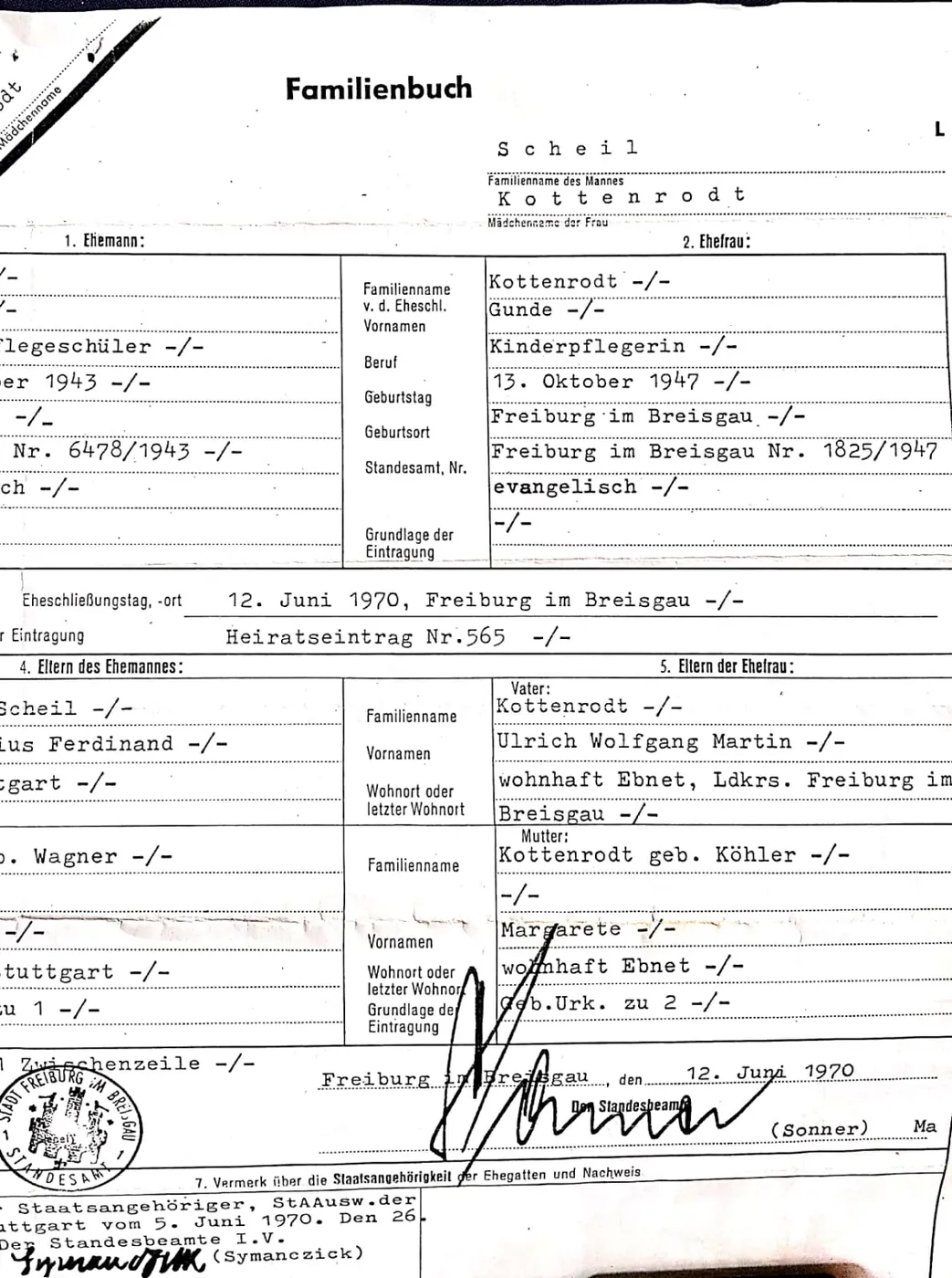
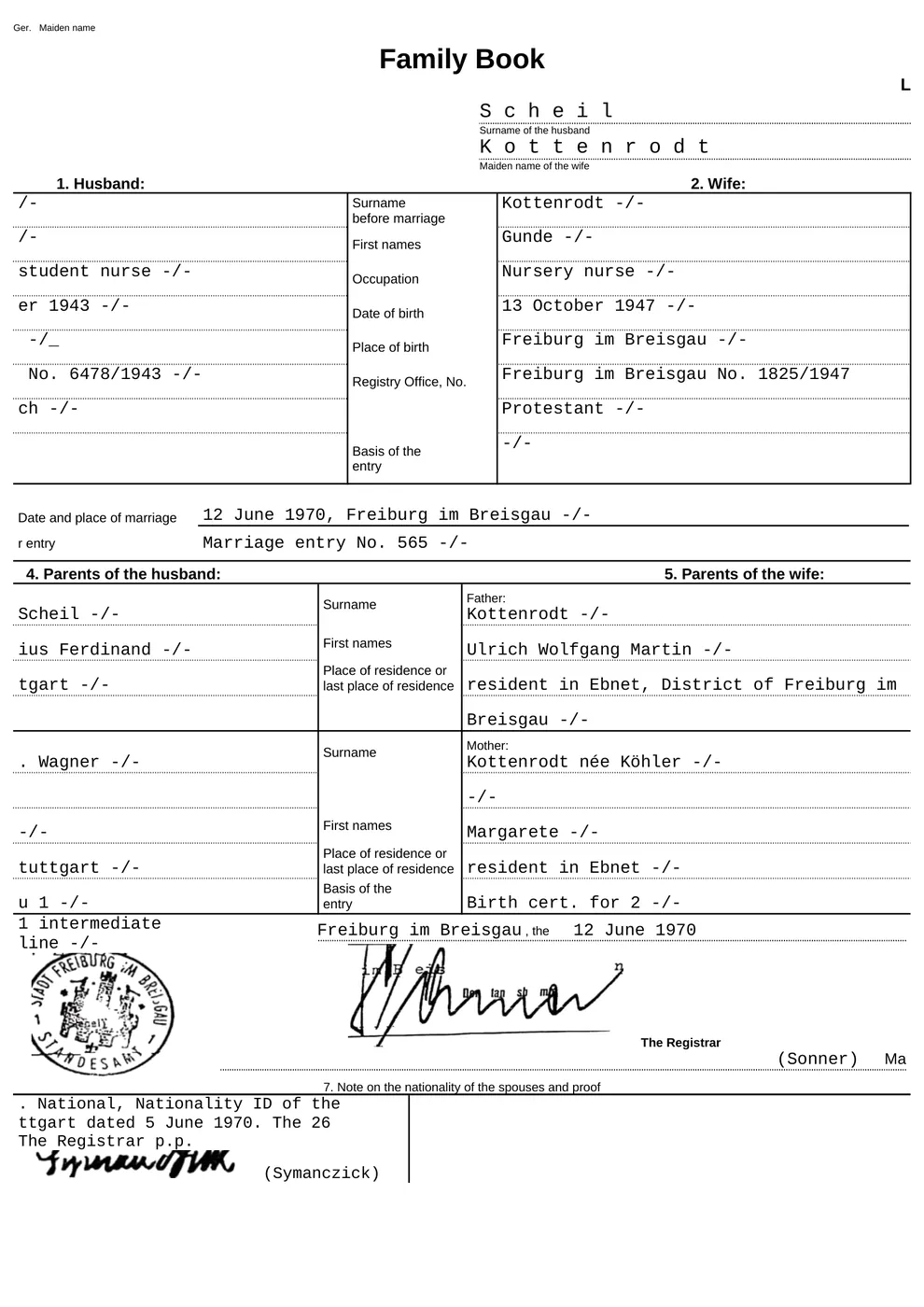
On a scanned document, the stamp stays as a picture where it was printed, and a small note in brackets goes right under it with the words read from the stamp, such as “[Stamp: …]”. I use that approach because a certified translation has to translate the stamp too, and retyping a round stamp by hand is where words get lost.
A translation that reproduces only the main paragraph can leave out the issuing authority or other information printed around a seal. Check the complete scan, including corners and margins, and ask whether every readable stamp and handwritten note will be represented.
Apostille, legalization, and recognition are different¶
An apostille is an official certificate that authenticates the signature, the capacity of the person who signed, and the seal or stamp on a public document. It doesn’t translate the diploma and doesn’t confirm that the degree is academically equivalent to a qualification in another country (HCCH, Ukraine competent authority information, guidance as of November 2026).
The receiving authority decides whether an apostille is required for the application. Don’t assume that every diploma submitted to Germany needs one, and don’t assume that a translation replaces an apostille if one is requested.
HCCH lists Ukraine’s Ministry of Education and Science as the competent authority for apostilles on official documents issued by educational institutions and organizations in education and science. Apostilles on notarizations or notarial documents fall under a different competence, including the Ministry of Justice (HCCH, Ukraine competent authority information, guidance as of November 2026).
The Ministry of Education and Science warns that it may send an official request to the issuing institution when it needs confirmation that a document was issued. The institution may take a month to consider that request, which can extend the apostille process. The ministry also lists reasons for refusal, including inability to confirm the signature or the signer’s authority, and a document that doesn’t match the required specimen or requirements (Ministry of Education and Science apostille guidance, guidance as of November 2026).
A fee figure can be misleading if it belongs to a different authority. The Ministry of Justice reported a fee of 670 UAH for individuals and 1,160 UAH for legal entities for apostilles on documents from justice bodies, courts, state archives, and notarial documents submitted from January 1, 2026. Those figures aren’t the fee for an apostille from the Ministry of Education and Science on an educational diploma (Ministry of Justice notice, tariff from January 1, 2026).
Recognition is another separate step. An apostille authenticates a signature and seal; a translation communicates the document’s contents; a recognition authority assesses the qualification under its own process. One doesn’t replace the others.
Pitfalls that can delay an application¶
The most avoidable problem is ordering a translation before confirming the recipient’s document list. ZAB cautions applicants to use the general checklist only when no country-specific page exists. A translation prepared to the general list may not settle what a particular application needs (ZAB general checklist, guidance as of November 2026).
Another risk is sending originals when copies are requested. ZAB says, “Please do not hand in original documents.” Its guidance explains that originals are returned with the Statement of Comparability, but the authority doesn’t take responsibility for them (ZAB general checklist, guidance as of November 2026). Follow the required copy format instead of mailing an original for reassurance.
A third mistake is treating the degree name as a translation problem alone. Transliteration, literal translation, and academic equivalence are different things. Berlin’s instructions explain how foreign degrees may be written when used in Berlin, while a ZAB application follows its own assessment and document rules. Don’t turn a transliterated title into “Dr.” simply because the German abbreviation looks familiar (Berlin guidance, guidance as of November 2026).
Incomplete scans cause a different kind of trouble. The main text may be sharp while a round stamp, signature, or reverse-side note is cut off. Ask for a complete, legible scan before translation starts, then review the result against the source.
Forum discussions about German recognition show why another applicant’s experience shouldn’t be treated as a universal checklist. A user asks whether a certificate of postgraduate study is needed to confirm a Candidate of Sciences diploma, and replies describe different situations. The discussion is anecdotal, not an official rule (forum discussion, discussion as of November 2026).
As the user puts it:
“Для подтверждения диплома кандидата наук нужна справка об окончании аспирантуры?”
“Is a certificate confirming completion of postgraduate study needed to confirm a Candidate of Sciences diploma?”
The question is useful because it names a real uncertainty, but the forum can’t answer for every ZAB, university, or employer application. Check the exact recipient’s list before adding or omitting a postgraduate certificate.
A translation that misses part of a seal can also create a mismatch between the original and translated pages. Ask the translator to account for stamps and seals, and check that the note identifies the visible wording rather than guessing at unclear text.
FAQ¶
How should I translate a Candidate of Sciences diploma for a German university?¶
Use the exact wording on the diploma and follow the university’s checklist. For a ZAB application, check the country-specific guidance and the relevant document list before ordering a translation.
Do I need an apostille on a Candidate of Sciences diploma for Germany?¶
Not automatically. An apostille authenticates an official signature, the signer’s capacity, and a seal or stamp; the receiving institution decides whether it requires one (HCCH guidance, guidance as of November 2026).
Does ZAB require a translation of a Candidate of Sciences diploma?¶
ZAB’s general checklist asks for a German translation when a document isn’t in one of the languages it lists as not requiring translation. It asks for certified copies of the diploma and academic transcript but says the translation itself is submitted as a regular copy; check the country-specific instructions first (ZAB checklist, guidance as of November 2026).
Can I translate Candidate of Sciences as PhD or use Dr. in Germany?¶
Don’t replace the awarded title with “PhD” or “Dr.” without authorization from the relevant authority. Berlin guidance says a foreign title is usually used in its original form, with Latin transliteration and a literal translation in parentheses where useful (Berlin guidance, guidance as of November 2026).
Do I need to translate the supplement to a Candidate or Doctor of Sciences diploma?¶
Translate the supplement or academic transcript if the recipient asks for it. ZAB’s general checklist asks for the diploma and academic transcript, and requests earlier degrees and transcripts when assessing a doctoral qualification if those degrees were earned (ZAB checklist, guidance as of November 2026).
Will ZAB accept the original diploma?¶
ZAB says not to submit original documents. Its guidance says originals are returned with the Statement of Comparability, but the authority doesn’t take responsibility for them (ZAB checklist, guidance as of November 2026).
Does an apostille prove that my degree is equivalent to a German one?¶
No. An apostille authenticates a public document’s signature, the signer’s capacity, and its seal or stamp. Academic equivalence is a separate assessment by the relevant authority (HCCH guidance, guidance as of November 2026).
Need these documents translated?
Leave your number and we will message you, tell you which certification your institution needs, and name the price. Translation, translator review and notary certification.